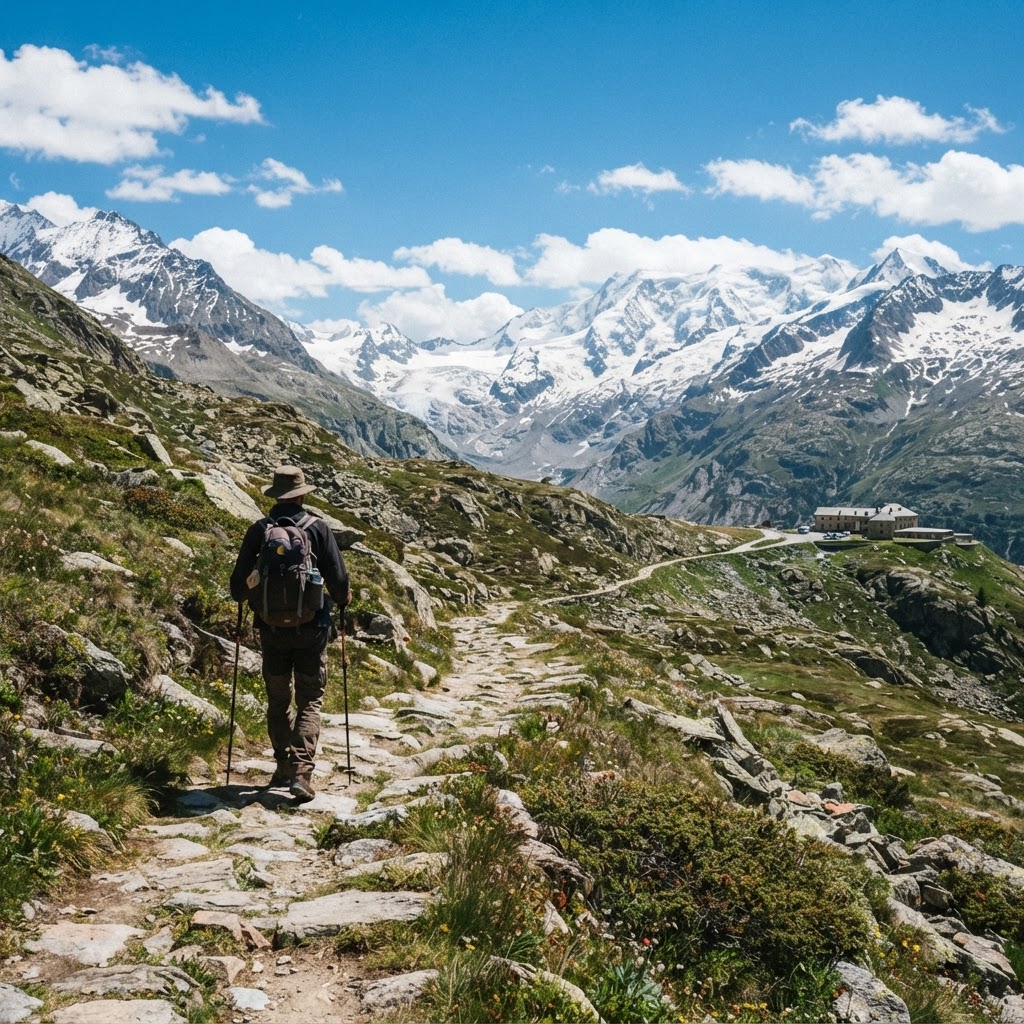
How Many Days Does the Via Francigena Take?
The full Via Francigena from Canterbury to Rome is roughly 2,000 km, and most walkers need 75 to 90 days to complete it end to end at a steady pace. But very few people walk the entire route in one trip — and you don't have to. Here is how to think about duration, daily distance, and the most popular section lengths.
Typical pacing
- Easy pace: 15–18 km/day — ideal for beginners, with time to explore towns
- Standard pace: 20–25 km/day — the most common choice for fit walkers
- Fast pace: 28–35 km/day — experienced, light-pack walkers only
Build in one rest day per week and a few buffer days for weather, blisters, or a town you want to linger in. On the Via Francigena, services are sparser than on the Camino, so rest days tend to fall in larger towns like Reims, Lausanne, Aosta, Pavia, Parma, Siena, and Viterbo.
Popular section lengths
- Last 100 km (Acquapendente → Rome): ~6 days — the minimum for the Testimonium
- Tuscany (Lucca → Rome): ~300 km, ~15–18 days — the most scenic and popular stretch
- Italy only (Vercelli → Rome): ~1,000 km, ~45–55 days — qualifies for the Testimonium
- Full route (Canterbury → Rome): ~2,000 km, ~75–90 days
What affects your duration
Terrain varies enormously. France's Champagne and Picardy are flat farmland; the Alps (Great St Bernard Pass) is a stiff climb at 2,469 m; Tuscany is rolling hills. The Po Valley in summer can be brutally hot and slow. Season matters too — alpine sections can be snowed in until June, and the Italian plains are best avoided in July and August.
How to plan your stages
Use the planner to set your start and end towns, daily distance, and start date. It will generate day-by-day stages with distances, towns, and accommodation suggestions — then you can adjust any single day to be longer or shorter as the terrain dictates.
A realistic approach
If you have two to three weeks, walk Tuscany. If you have six to eight weeks, start in northern Italy and walk to Rome. Only commit to the full Canterbury-to-Rome route if you have a full summer and a taste for long, self-supported walking. There is no wrong way to do the Via Francigena — only the way that fits your time.
Explore the Via Francigena
Via Francigena
Plan your Via Francigena
How long the Via Francigena takes: typical durations for the full 2,000 km and the most popular sections, pacing, rest days, and how to fit it into your schedule.