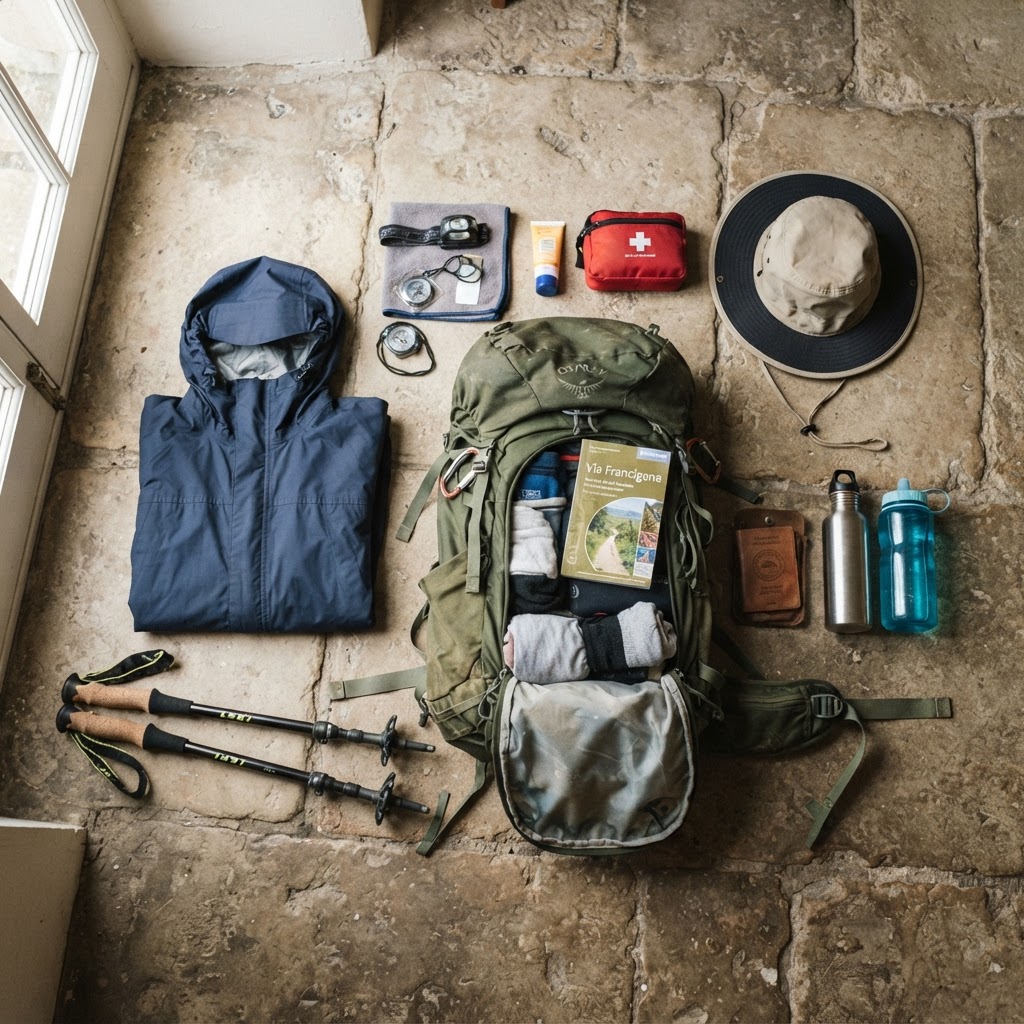
Via Francigena Packing List: What to Carry from Canterbury to Rome
The Via Francigena crosses four countries and climates, from the damp English spring to alpine snowfields and the baking Italian summer. Your pack needs to handle all of it — while staying light enough to carry for up to 90 days. Here is a practical, season-flexible packing list.
The backpack
Aim for a loaded pack of 8–10 kg (including water). A 38–45 litre backpack with a good hip belt is ideal. Do not overpack — you can wash clothes every two days and buy anything you forget.
Clothing (layered for four climates)
- 1 pair broken-in trail shoes or light boots (waterproof if walking the Alps in spring/autumn)
- 3 pairs merino socks (one spare, one drying)
- 2 quick-dry hiking shirts
- 1 long-sleeve base layer (for the Alps and evenings)
- 1 lightweight fleece or insulated jacket
- 1 waterproof rain jacket (essential — rain is common in England and France)
- 1 pair lightweight rain pants
- 1 pair convertible or quick-dry hiking trousers
- 1 set of evening clothes (lightweight, for restaurants and monasteries)
- Sun hat and a warm beanie (alpine mornings are cold)
Sleeping and shelter
Most walkers carry only a silk liner — accommodation is in B&Bs, agriturismi, monasteries, and small hotels. If you plan to camp (rare but possible in France), carry a lightweight tent and bag. A liner is enough for the vast majority of pilgrims.
Toiletries and first aid
- Basic toiletries (travel-size)
- Sunscreen (the Italian sun is strong)
- Blister kit: Compeed or moleskin, tape, alcohol wipes, scissors
- Small first-aid kit: plasters, painkillers, antiseptic
- Any personal medication, plus a copy of prescriptions
Documents and electronics
- Pilgrim credential (credenziale) — get it before you start; stamp it daily
- Passport and EHIC/GHIC or travel insurance card
- Phone with offline maps (the Via Francigena is less waymarked than the Camino — navigation matters)
- Power bank and a European plug adapter
- Headlamp (early alpine starts, late arrivals in winter)
Water and food
Carry at least 1.5 litres — more in the Italian summer, when gaps between services can be long. A collapsible bottle saves weight. Snacks are easy to buy, but carry emergency biscuits for the alpine stages.
What to leave behind
A second pair of shoes, a bulky towel (a microfibre one is enough), a heavy guidebook (carry the app or a photocopy of key pages), and "just in case" extras. Every extra kilogram compounds over 2,000 km.
Pack for the worst section you'll cross, not the average day — that means rain gear for England and France, and sun protection for the Po Valley. Get it right, and the walk takes care of itself.
Explore the Via Francigena
Via Francigena
Plan your Via Francigena
A practical packing list for the Via Francigena: a light backpack, layered clothing for four climates, rain gear, blister kit, pilgrim credential, and what to leave behind.