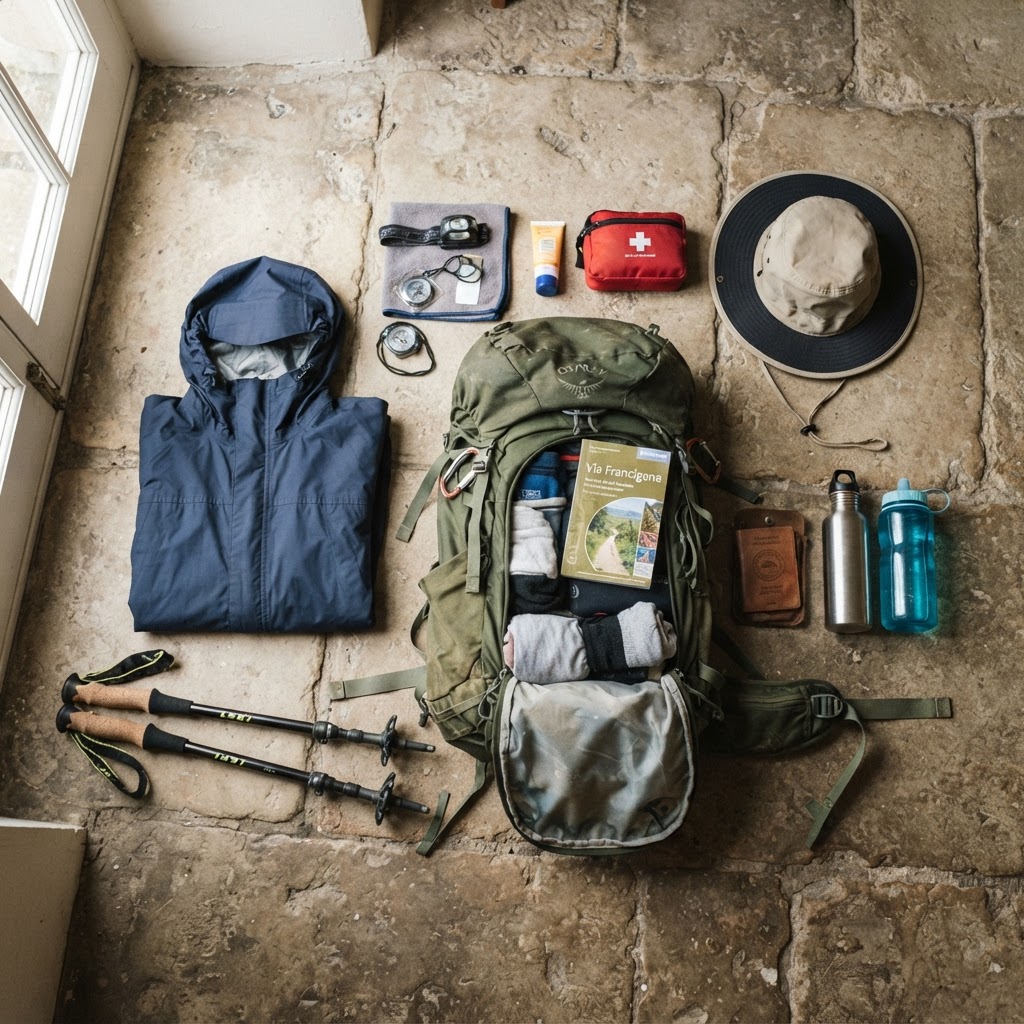
The Via Francigena in the Aosta Valley
Crossing the Great St Bernard Pass brings you into Italy — and into the Aosta Valley, a region of Roman ruins, Alpine valleys and the first Italian towns of the pilgrimage. It's a short section (~80 km, 3 stages) but a dramatic one: a long downhill from the Alps into the Po Valley.
The route
Aosta: the first Italian town, founded by the Romans as Augusta Praetoria. Its Roman ruins (the arch, the theatre, the forum) and the cathedral make it one of the route's great half-day stops. Stamp your credential at the cathedral and rest after the pass.
Aosta → Pont-Saint-Martin: down the Aosta Valley, following the Dora Baltea. Pont-Saint-Martin has a remarkable Roman bridge still in use after 2,000 years — a vivid reminder that the Via Francigena is older than the Camino.
Pont-Saint-Martin → Ivrea: continuing the descent into the Canavese plain. Ivrea is famous for its Olivetti industrial heritage and its castle; the route then flattens as it approaches the rice plains of Vercelli.
Terrain and difficulty
Almost entirely downhill — a relief after the pass, but long descents are hard on the knees. Take them slowly, tape any twinges, and don't be afraid to break a long descent into two short stages. The walking is on paths, minor roads and the old Roman road in places.
What to see
- Aosta: Roman theatre, arch, cathedral, the regional archaeological museum.
- Pont-Saint-Martin: the Roman bridge and the medieval castle above the town.
- Ivrea: the castle, Piazza Mancini, and the Olivetti heritage sites.
Food
Aosta Valley cuisine is hearty mountain food — fontina cheese, polenta, carbonade (a beef and red wine stew), and the local coppa dell'ambrogiana salami. Try a bowl of polenta concia (polenta melted with fontina) after a cold descent.
Planning
3 comfortable stages (Aosta → Pont-Saint-Martin → Ivrea → Vercelli). Aosta has pilgrim accommodation and convents; book ahead in summer. From Ivrea the route continues onto the Po Valley — read the Po Valley guide for the long, flat stages ahead. Use the planner to map Aosta → Vercelli and set a relaxed pace while your legs recover from the pass.
Explore the route
Via Francigena
Plan your Via Francigena
Crossing into Italy: Aosta's Roman ruins, Pont-Saint-Martin and Ivrea — the descent from the Alps into the Po Valley.