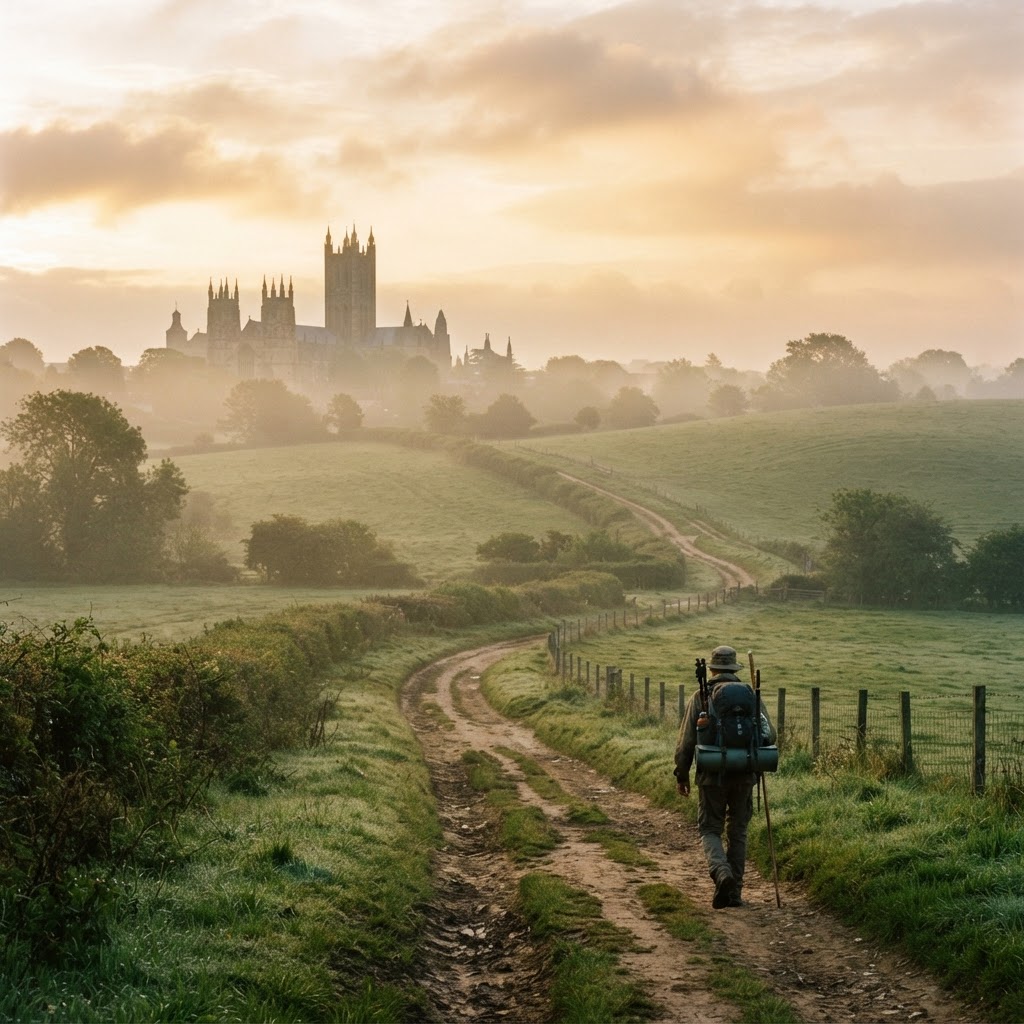
Sigeric's Journey — The 990 AD Route That Defined the Via Francigena
In 990 AD, an English archbishop walked from Canterbury to Rome to receive his pallium from the Pope — and on the way back, he wrote down the names of the 79 places he stayed. That single document, preserved in the Canterbury archives, is the reason the modern Via Francigena runs where it does.
Who was Sigeric?
Sigeric the Serious was Archbishop of Canterbury from 989 to 994. (The nickname "Serious" — Serius — appears in later sources, possibly a play on his temperament.) In 990 he travelled to Rome to receive the pallium, the woollen band conferred by the Pope on archbishops as a sign of their authority. His journey there and back took him across England, France, Switzerland and Italy — exactly the four countries the modern route crosses.
The 79 stages
On his return journey, Sigeric recorded the names of the 79 stage-towns where he and his party stopped for the night. The list runs from Rome back to Canterbury, and it includes names still central to the route: Sutri, Viterbo, Siena, Lucca, Parma, Piacenza, Pavia, Vercelli, Aosta, the Great St Bernard (summus Penninus), Martigny, Lausanne, Besançon, Langres, Reims, Laon, Arras, Thérouanne, Calais, Dover and Canterbury.
This list is extraordinary. It is a snapshot of the medieval road network of Europe, written by someone who actually walked it. And it has survived for over a thousand years.
Why Sigeric matters today
The modern Via Francigena, revived from the 1980s onward, uses Sigeric's stages as its blueprint. Where his route can still be walked (and most of it can), the modern waymarked path follows it — through the same cathedral cities, the same Alpine passes, the same Tuscan hill-towns. When the route deviates, it's usually because a medieval road has become a motorway or a town has shifted.
Without Sigeric's list, the Via Francigena would be just another lost medieval route. With it, the route has a documented 1,000-year history — and a line on the map that pilgrims can still follow.
Walking in Sigeric's footsteps
When you walk the Via Francigena, you walk the same stages Sigeric recorded — only with better shoes, GPS, and pilgrim hostels. The Great St Bernard Hospice that sheltered him still shelters walkers; the cathedrals of Reims, Aosta, Lucca and Siena still stand; the white roads of Tuscany still climb to Radicofani.
Sigeric's journey took weeks. The modern route takes about 90–100 days at a pilgrim pace. Read the History guide for the full story, and use the planner to map your own Canterbury-to-Rome stages — and add your name to the thousand years of pilgrims who have walked them.
Explore the route
Via Francigena
Plan your Via Francigena
In 990 AD Archbishop Sigeric of Canterbury walked to Rome and recorded 79 stages — the document that still defines the modern Via Francigena.