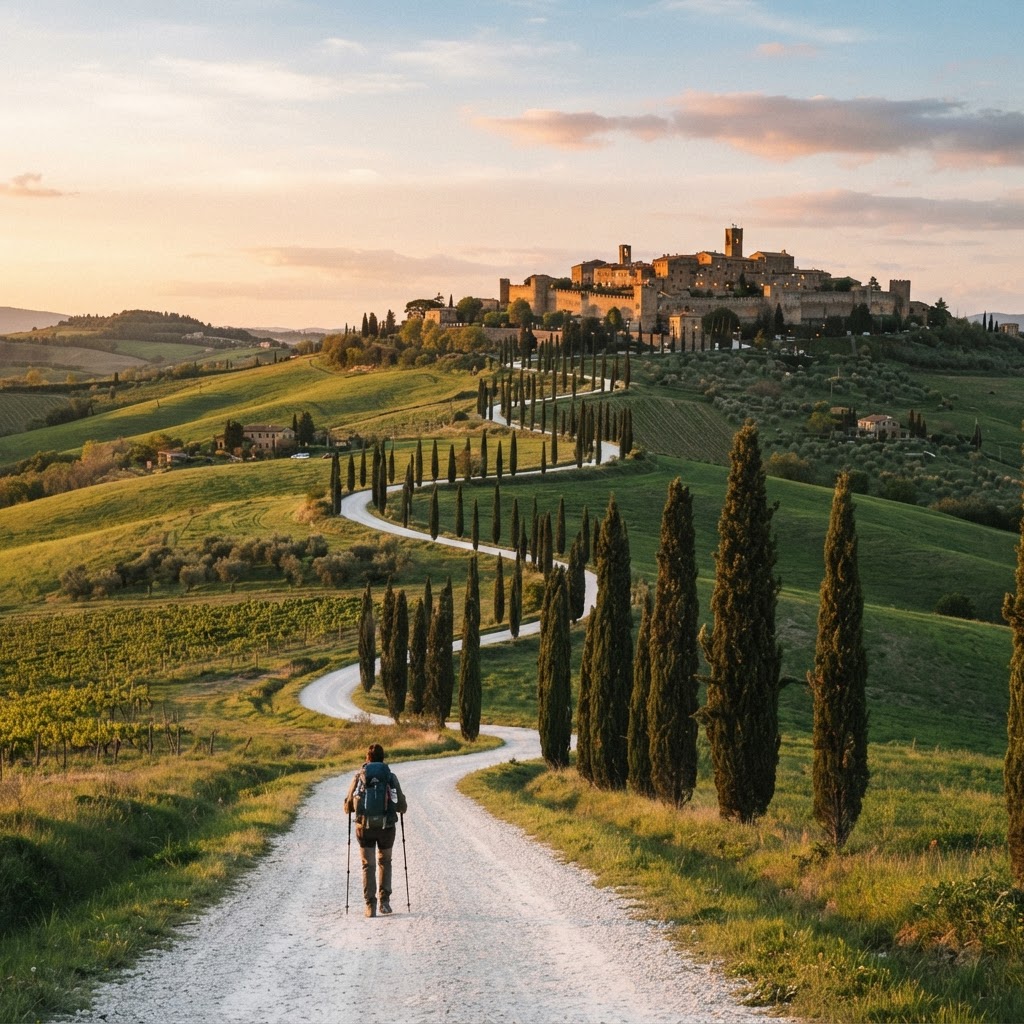
The Via Francigena in Switzerland — Lake Geneva to the Alps
The Swiss section is short — about 160 km over 6–7 stages — but it contains the route's highest, most dramatic and most weather-dependent walking. From the Jura descent into Yverdon, along Lake Geneva to Lausanne, through the Lavaux vineyards to Martigny, and up the long climb to the Great St Bernard Pass.
The route
Sainte-Croix → Lausanne: the route drops off the Jura into Yverdon-les-Bains (thermal baths), then follows the northern shore of Lake Geneva through Lausanne — the Olympic city, with its cathedral and lake views.
Lausanne → Martigny: the lakeside path through the Lavaux vineyards (UNESCO World Heritage) — terraced vines above the lake, one of the most beautiful walking days in Europe — through Vevey and Montreux to Villeneuve, then up the Rhône valley to Martigny (Roman amphitheatre, Fondation Gianadda).
Martigny → Great St Bernard Pass: the big climb. Sembrancher, Bourg-Saint-Pierre, and the long ascent to the pass at ~2,469 m and the famous hospice. This is the route's high point — literally.
The Great St Bernard Pass
The pass is usually open June to September only. Outside that window it's snow-covered and the road closes; you'll use the tunnel (with a shuttle bus) or a bus transfer from Martigny to Aosta. Even in summer, check the forecast — snow can fall above 2,000 m well into July. See the dedicated Great St Bernard Pass guide.
Difficulty
This is the most demanding section on the route. The climb to the pass is long, the altitude is real, and the weather can turn. Carry warm layers even in July. The descent into Aosta is long and hard on the knees — take it slowly.
Accommodation and cost
Switzerland is the most expensive country on the Via Francigena. Hostels €40–60, a simple meal €20–30, a grocery sandwich €10. Self-cater from Migros or Coop to keep costs down. Book Martigny and Bourg-Saint-Pierre well ahead in summer.
Planning
Allow 7 days for the Swiss section and build in a weather-day buffer for the pass. Use the planner to map Sainte-Croix → Aosta, and read the Aosta Valley guide for the descent into Italy.
Explore the route
Via Francigena
Plan your Via Francigena
The Swiss section: Lausanne, the Lavaux vineyards, Martigny and the climb to the Great St Bernard Pass — the route's highest and most dramatic stages.